
Should I Introduce a Mental Health App To My Child? Research Says Try It Together First
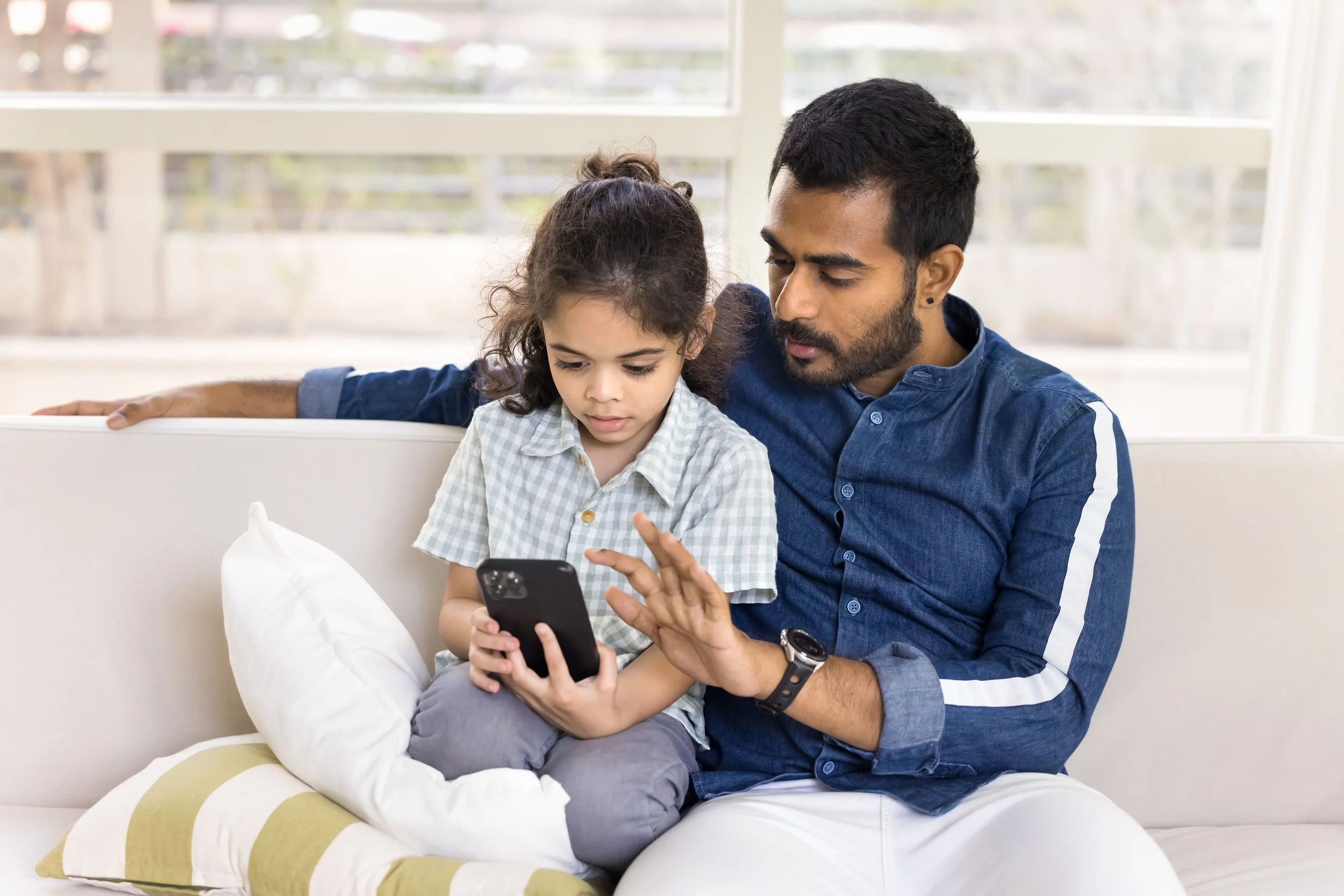
More parents are turning to mental health apps to help their kids manage anxiety, big emotions, and tough moments. What's less clear is what your role should be once the app is on their phone.
Bottom line: Yes — many parents should try a mental health app with their child first, especially for younger kids and early teens. Research suggests mental health apps tend to be more useful for kids when they're connected to real-life support. The goal is not to monitor what your child does in the app. It's to model coping skills, help them choose a tool, respect their privacy, and gradually let them use it independently.
Most parents end up doing one of two things: they hand the phone over and hope the app does its job, or they hover and check what their kid is tapping. There's a third path that research increasingly supports — and it isn't either of those.

The short answer: use the app together, then give them space
Mood has found that an effective, research-supported approach to parent-and-child mental health app use looks like this:
Try the app together first — sit with your kid for the first few sessions, learn what it does, and try a tool side by side.
Shift into coaching — over time, move from "doing it with them" to "available if they need" mode. Praise the practice, not the result.
Respect their privacy — be clear about what you will and won't look at. Let them choose when to share.
Stay available — the most common app usage pattern families report is that their child is “mostly independent with some adult support” — not constant oversight, and not “you’re on your own.”
EVIDENCE AT A GLANCE:
| Parent Question | What the Research Suggests | What Parents Should Do |
|---|---|---|
| How do I find a mental health app that is appropriate for my child? | Kids and teens need low-friction, privacy-conscious tools that support multiple use modes. | Look for low sign-up friction, clear privacy language, and quick coping tools, like those found in The Mood Tools App. |
| Should I give my child a mental health app to use alone? | Purely solo use may lose some of the benefit of real-life support. | Try the app together first, then offer privacy. |
| Should I monitor what they do in the app? | Parent involvement works better as coaching or scaffolding, not surveillance. | Ask supportive questions instead of checking or policing use. |
| Will my child want me involved? | 93.5% of parents would use a mental health app collaboratively with their child, 93.5% believe their child would be open, and 98.5% of professionals support the model. Direct teen voice: 52% are comfortable talking with parents about mental health. | Offer involvement as a choice, not a requirement. |
Why mental health apps can work better with real-life support
The most direct evidence comes from a 2021 multinational review by Lindsay Dewa and colleagues, which introduced the Quality Social Connection (QSC) framework. The core finding, and evidence in many youth digital mental health contexts, points toward a hybrid model — digital tools tend to work better when they're connected to real-life support, not used in isolation.
That pattern is consistent across broader literature. A 2025 umbrella review of 51 studies of digital mental health interventions for ages 0–25 found that across youth research, guided or supported use often performs better than purely self-guided use, especially when the support isn't framed as surveillance.
The takeaway for parents: it's not the app or you that matters most. It's both.
Coaching, not monitoring: what parent involvement should look like
This is where most parents accidentally get it wrong. The instinct when your kid is using a mental health app is to check on it — read what they're typing, ask whether they "did" their exercise. That instinct is understandable but counterproductive.
A 2024 systematic review of parental involvement in digital cognitive behavioral therapy (CBT) for child anxiety found that parent involvement is associated with better engagement — but the kind of involvement matters. Effective involvement looks like coaching or scaffolding. Ineffective involvement looks like monitoring.
What does coaching mean in practice? The literature points to five specific behaviors:
Autonomy-supportive prompting. Instead of "Did you do your Mood exercise?" try "What Mood Tool do you want to try if you feel anxious tonight?" Choices, not orders.
Modeling shared coping language. Use the app's vocabulary when you're stressed. "I think I need to take a break and try a breathing tool right now."
Environmental scaffolding. Help set up the conditions for use. Make time to be available. Build a quiet-time routine where the app can fit in naturally.
Praise the practice, not the outcome. "I'm proud of you for trying that tool." works better than "Great, you feel better now." Skill-building has uneven results, and praising outcomes makes practice feel like failure when emotions don't shift.
Talk about privacy explicitly. Tell them what you will and won't look at. If you're going to respect the contents of their phone, say so out loud. The clarity itself reduces resistance.
How to introduce a mental health app without making it weird
A few practical scripts grounded in the autonomy-supportive framing:
| Moment | What to Say or Do |
|---|---|
| The first conversation | "Hey, your counselor mentioned this app called The Mood Tools App. Let’s try it together to understand what it does — and then you can decide if you want to use it on your own or with me." |
| The Setup | Sit next to them, not in front of them. Let them tap through. Read the descriptions out loud. Make it a shared discovery rather than a handoff. |
| The First Use | Pick a low-stakes moment — not the middle of a meltdown. *Try one tool together: a breathing exercise, a grounding prompt, a mood check-in. Treat it like learning to ride a bike: you're the support, not the driver. |
| The Handoff | After a few sessions: "Do you want to keep doing this with me, or do you want to try it alone?" The autonomy itself is part of what works. |
| The Check-in | Once a week, ask: "How's it going with The Mood Tools App?" — not "Did you use it?" The first invites a real answer. The second invites a yes or no. |
*Note: The first tool does not need to be a calming exercise. For some kids, the better first step is naming what they feel before trying to change it. A simple "mood check" or "what's coming up for you right now" prompt is often a more useful entry point than a breathing exercise — especially when the immediate problem is feeling stuck or overwhelmed, not feeling activated.
When to let your child use the app independently
You don't have to co-use forever. Mood’s 2026 Parent Survey found that a mix is what actually happens in real households: 44.5% of kids use mental health apps "mostly on their own with some adult support," 27.5% entirely on their own, and 14% with a parent. Some weeks, your kid will want you near. Other weeks, they'll want privacy. Both are valid.
The transition doesn't have a fixed timeline. Younger kids (9–12) often stay in earlier modes longer; older teens (13+) often move toward independence faster. The best approach is flexible: start together, then let your child lead more over time.
Across the evidence, purely solo use may lose some of the benefit of real-life support. Purely adult-driven use can lose the autonomy that kids and teens need. The middle — your presence as a coach, available but not hovering — is the practical model this research points toward.
What to look for in a mental health app for kids and teens
If you're going to use a mental health app with your child, look for tools designed for collaborative use:
Designed for kids and younger teens, especially the 9–15 range, where parent involvement, emerging autonomy, and device access overlap.
Transparent about what's tracked and stored. You should know what data exists, even if your child is the one using the app.
Built on evidence-based frameworks — CBT, DBT, mindfulness — with documented use protocols, not just vibes.
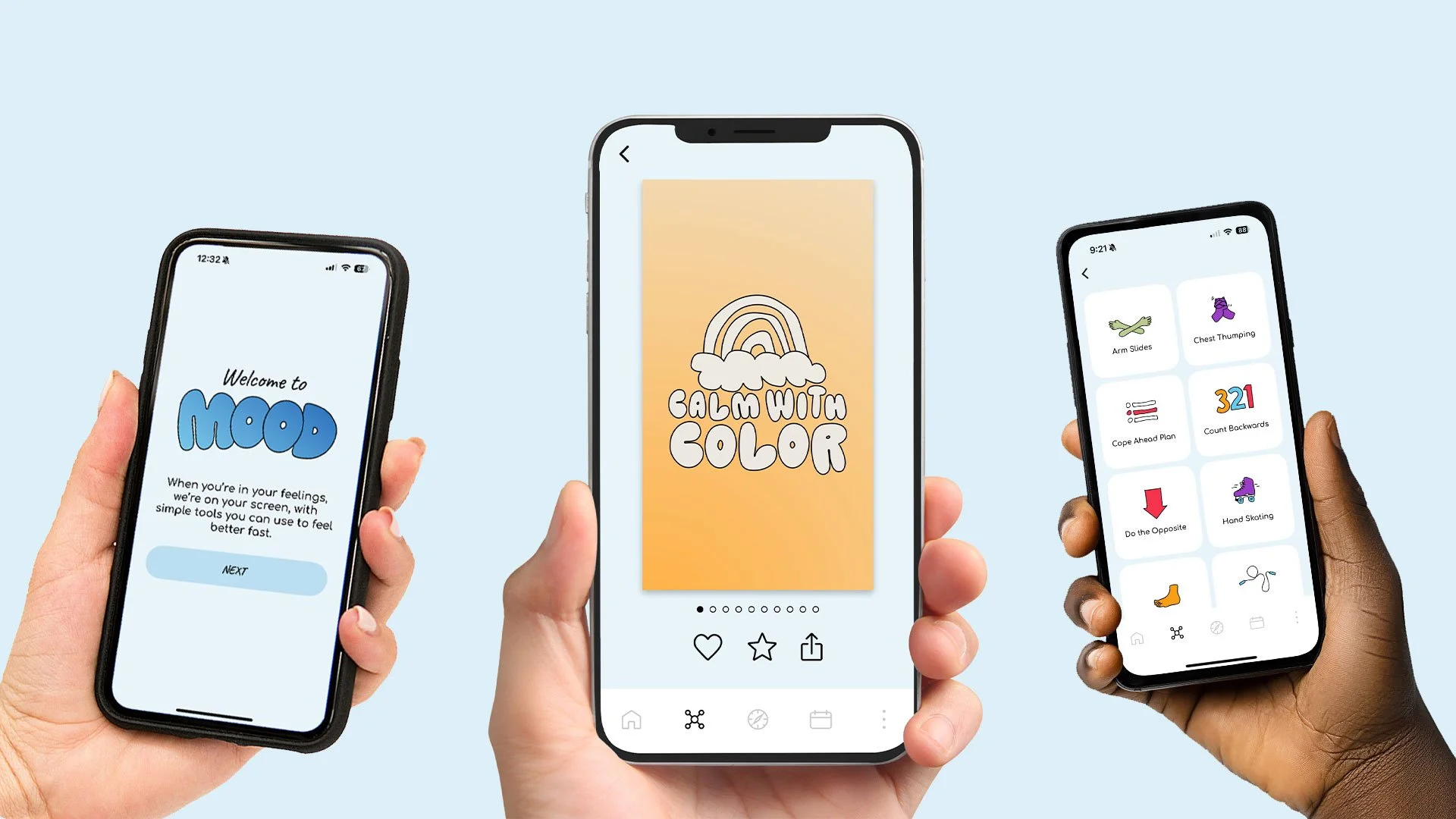
The Mood Tools App was designed to support this kind of flexible use: a child can open it independently, but a parent, caregiver, counselor, or educator can also sit beside them and try a short coping tool together. Mood is free, easy to use, and includes coping tools informed by CBT, DBT, mindfulness, breathing, and grounding practices.
What this does not mean
Using a mental health app with your child does not mean:
Reading everything they write or track.
Watching them complete exercises like homework.
Treating the app as a replacement for therapy, school support, pediatric care, or crisis resources.
Insisting on collaborative use when your child wants privacy.
The strongest model is supported without surveillance. Help your child try the tool. Talk about privacy clearly. Let them choose when they want help and when they want space. If your child is in crisis, an app is not the right tool — call or text 988 (the U.S. Suicide & Crisis Lifeline) or your child's mental health provider directly.
Frequently asked questions:
-
For many families with kids ages 9–15, yes — at least at first. The research supports a hybrid model: try the app together, use it as a coaching tool, and shift toward independence as your child is ready.
-
Try it together yourself first. Sit beside them, not in front of them. Let them tap through. Pick a low-stakes moment for the first try (not a meltdown). Praise the practice, not the outcome. After a few sessions, give them the choice to continue together or alone.
-
The research suggests no, at least not in the surveillance sense. Effective parent involvement looks like coaching or scaffolding (asking how it's going, modeling shared coping language), not monitoring (checking what they typed, reading their entries). Be clear up front about what you will and won't look at.
-
This varies by app. Look for tools that are transparent about what's tracked and stored, that don't sell user data, and that don't require an account. Privacy specifics belong in the app's privacy policy — read it before introducing the app to your child, and explain the relevant parts to them in plain language.
For kids and teens, privacy is not just a technical feature; it is part of whether they feel safe enough to use the tool honestly.
-
No. Mental health apps are best understood as a coping-skill layer that fits between casual self-help and acute care. They can teach techniques, support practice, and serve as a bridge — but they're not a substitute for therapy, a school counselor, pediatric care, or crisis resources.
-
The 9–15 range is a strong practical fit because it overlaps parent involvement, emerging independence, and increasing device access. The evidence is clearest for different pieces of that range in different ways: younger kids often need more adult support, while early teens are beginning to use tools more independently. For children under 9, adult-guided coping tools tend to work better than app-based ones. For older teens (16+), autonomy preferences shift — many prefer apps with adult-style framing rather than kid-oriented design.
-
An app is not the right tool for a crisis. In the U.S., call or text 988 (the Suicide & Crisis Lifeline) for free, confidential support 24/7. Reach your child's mental health provider, pediatrician, or local emergency services if you're worried about immediate safety. Mental health apps are designed for ongoing coping; they are not designed for emergency support.
A mental health app should not replace the parent-child connection. It should give that connection something practical to do together.
Sources
Dewa, L.H. et al. (2021). A Multinational Review of the Implementation and Effectiveness of Digital Mental Health Interventions for Young People. (QSC framework)
Liverpool, S. et al. (2025). Umbrella review of digital mental health interventions for young people aged 0–25.
Reardon, T. et al (2024). P rental Involvement in Digital CBT for Child Anxiety: A Systematic Review.
Mood Pollfish Parent Survey (n = 200 U.S. parents and caregivers of children ages 4–17), 2026.
Mood Pollfish Professional Survey (n = 200 youth-serving mental health and education professionals), 2026.